



Govt. job aspirants
Clerk, data entry and similar Punjab posts commonly include a Punjabi typing test — prepare for it properly.

Learn to type Gurmukhi by touch in Raavi and Asees — the fonts used in Punjab government offices and recruitment typing tests — with timed drills every day at the techcadd Computer Institute Jalandhar lab until speed and accuracy both show up on the test screen.
techcadd Computer Institute's Punjabi Typing course in Jalandhar is for anyone who needs to type Gurmukhi quickly and correctly — mostly candidates preparing for Punjab government clerk, data entry and similar posts, where recruitment commonly includes a typing test in Punjabi and English, and people who type Punjabi documents for offices and courts.
The first week is spent on the keyboard layout and correct finger placement, so you stop hunting for keys. You then learn Raavi, the Unicode font now standard in government offices, and Asees, the older legacy font many tests and offices still use — including how the two layouts differ. Matras, half letters (pairin), nasal signs and special characters get their own drills, because that is where most marks are lost.
The final part of the month is pure speed and accuracy: timed passages, error analysis and full mock tests set in the same pattern as recruitment typing tests. Your words per minute and accuracy are recorded each week, so you can see exactly where you stand before the real exam.
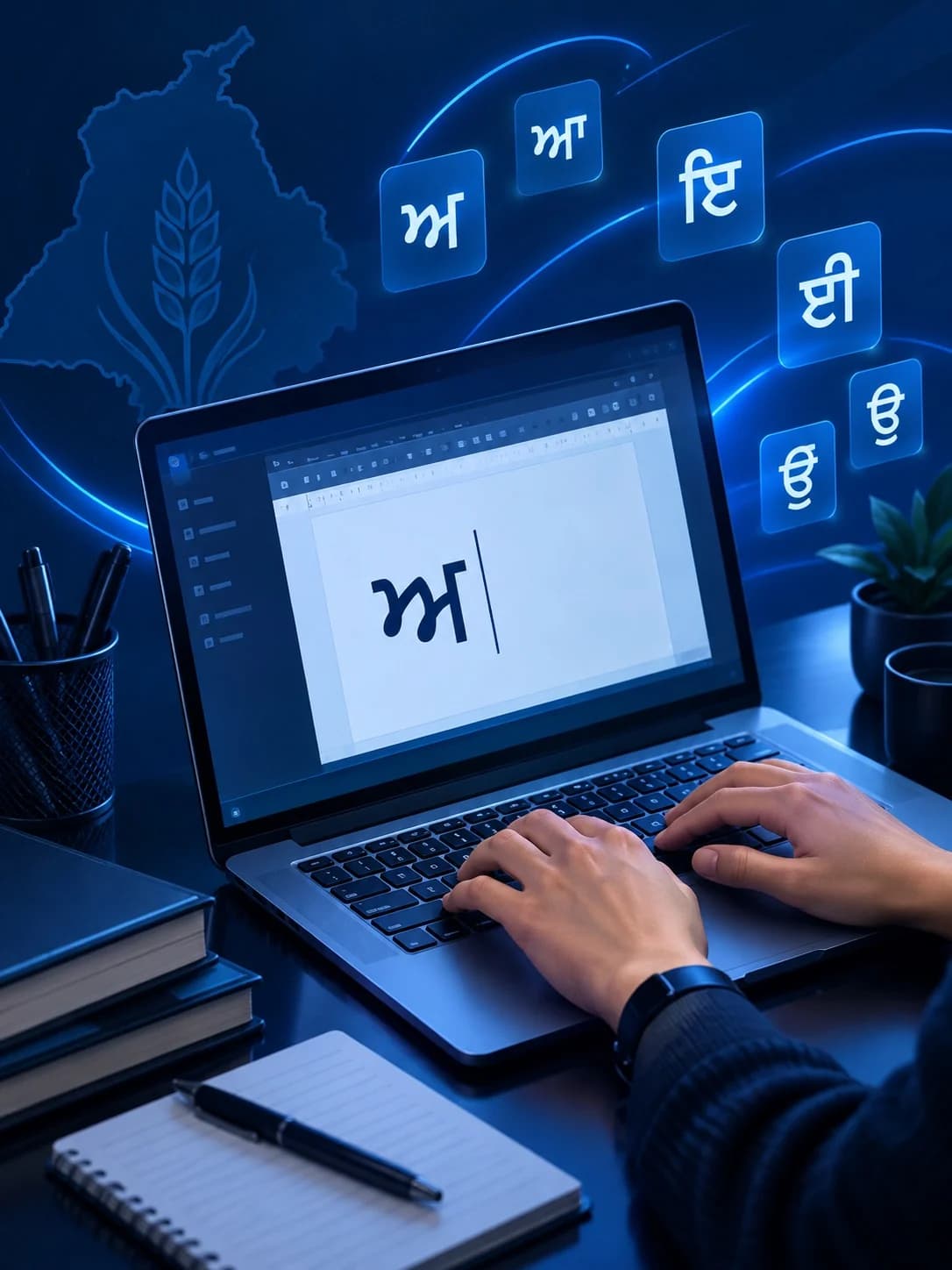 Timed practice every day
You only need to be able to read Punjabi. No typing experience is required — the course starts from finger placement on the home row.
Clerk, data entry and similar Punjab posts commonly include a Punjabi typing test — prepare for it properly.
Add a practical, test-ready skill to your degree while you apply for jobs and exams.
Start typing practice early so speed is already built when recruitment notices come out.
Type Punjabi letters, notices and records in Raavi without copying from others or using slow phonetic tools.
Move from slow two-finger typing to touch typing, and switch confidently between Raavi and Asees.
Take Punjabi typing work for advocates, schools, printers and religious organisations.
Aspirants come to the Jalandhar centre from Model Town, Adarsh Nagar, Basti Sheikh, Rama Mandi and Urban Estate, and from Kartarpur, Nakodar, Phagwara and Kapurthala for weekend batches. Morning, evening, weekend and 1-on-1 slots let you fit typing practice around coaching classes or a job — each class is guided teaching plus timed lab practice.
For many Punjab clerical posts, clearing the written exam is not the end — the typing test still has to be passed. Candidates lose selections here every year.
You learn correct finger placement from day one. Looking at the keyboard is slow, and it does not survive a timed test.
Offices have moved to Unicode Raavi, but Asees and other legacy layouts are still in use. You practise both, so the font on test day is not a surprise.
Every week you get a recorded speed and accuracy score. You always know how far you are from where you need to be.
The month moves from layout to fonts to speed: first your fingers learn where every letter lives, then the tricky characters, then timed passages until the numbers are steady.
Learn the layout properly so your fingers stop searching for keys.
Every lab computer is set up with Punjabi Unicode input, the Raavi and Asees fonts and typing-test software for timed practice.
 RaaviUnicode Gurmukhi font
 MS WordPunjabi documents
 WindowsPunjabi input setup
Complete the course and your final mock tests to receive a techcadd Computer Institute certificate that records your typing speed — verifiable online.
Indicative starting pay for private roles in Punjab. Government posts are paid as per government scale; private offers depend on the employer and your tested speed.
Court complexes, advocates' chambers and offices
Offices, contractors and record-keeping teams
Schools, clinics, offices and government contractors
Printing presses, publishers and newspapers
Yes. Many Punjab clerical and data-entry posts include a typing test in Punjabi and English. This course prepares the Punjabi side; the English & Punjabi Typing course covers both.
Both. Raavi (Unicode) is now the office standard, but Asees and other legacy layouts are still used. Always check the font named in the recruitment notice — we train you on both.
Yes. Punjabi typists are needed at courts, advocates' chambers, printing presses and offices, and many students take home-based Punjabi typing work.
English typing is the natural next step, since many tests include both. Basic Computer or MS Office also help for clerical roles.
Alongside the drills, you type the kind of Punjabi documents that offices actually produce.
Type and format a government-style application or office letter in Raavi, ready to print.
Retype a legacy Asees document in Unicode Raavi and compare accuracy line by line.
Type a passage full of matras and half letters with zero mistakes, then time it.
Sit a complete exam-pattern typing test and get your WPM and error report.
Every session ends with a number, so you always know whether you improved.
The trainer shows the keys, characters or technique for the day on the big screen.
e.g. Typing pairin lettersYou type a timed passage on your own computer while your speed is measured.
e.g. 5-minute Raavi passageYour errors are reviewed and you drill the exact words you got wrong.
e.g. Re-testing weak matrasPlenty of places in Jalandhar let you sit at a computer and type. What matters for a typing test is correct technique from day one, both fonts, and someone checking your errors every day.
Practice built around exam-pattern passages, speed and error counting.
Every minute of lab time is your own typing practice.
Your trainer checks your posture, fingers and errors every class.
Raavi (Unicode) and Asees, with practice switching between them.
Job-drive updates and resume help with 500+ hiring partners.
25,000+ students trained across Punjab, rated 4.9★ on Google.
Questions worth asking before you join any Punjabi typing course, including this one.
| Feature | techcadd Computer Institute | Typical institute |
|---|---|---|
| Technique | Touch typing with correct finger placement | –Self-practice, often two-finger typing |
| Fonts | Raavi (Unicode) and Asees | –Often only one font |
| Speed tracking | Weekly recorded WPM and accuracy | –Rarely measured |
| Mock tests | Exam-pattern timed tests | –Random passages |
| Error review | Mistakes reviewed and re-drilled | –Limited or none |
| Batch size | Small batches with individual attention | –Large, crowded batches |
| Timings | Morning, evening, weekend, 1-on-1 | –Fixed single slot |
| Certificate | Verifiable certificate with speed record | –Varies |
The right-hand column describes what is commonly offered in the market, not any particular institute.
Rated 4.9★ on Google by students of every age and background.
“I used to look at the keyboard for every letter. After a month of daily tests I type Raavi without looking, and my accuracy is much better.”
“The matras and half letters were my weak point. The trainer gave me word lists just for those and it really helped.”
“I learned Asees years ago but offices now want Raavi. This course made the switch easy.”
“Weekend batch suited me because of college. The mock tests felt close to a real typing test.”
“Now I type Punjabi letters and notices myself instead of asking someone else. Simple and practical classes.”
“Seeing my speed written down every week kept me practising. Good trainers, small batch.”
Still unsure? A counsellor can walk you through batches, fees and the syllabus in one short call.
📞No. You only need to be able to read Punjabi. The course starts from finger placement on the home row.
The course runs for 1 month. Morning, afternoon, evening and weekend batches are available, plus 1-on-1 slots on request.
Both. Raavi (Unicode) is the current office standard and Asees is still used in places, so you practise both and learn to switch between them.
Mock tests follow the general pattern of Punjab recruitment typing tests — timed passages checked for speed and errors. Always read the official notice for the exact rules of your exam.
Yes. You receive a techcadd Computer Institute certificate with your tested typing speed, which can be verified online.
This course focuses on Punjabi. If your exam needs both, the 2-month English & Punjabi Typing course covers both languages.
Yes. Book a free demo class, try the lab setup and meet the trainer before you decide.
Talk to a counsellor today. One conversation is usually enough to identify the right learning path, career direction, and training roadmap.
Book a free demo class and see the lab before you decide.